Folders & Access Control
Every organization has a folder tree for its skills. Folders keep large skill libraries navigable, define the directory layout of synced GitHub repos, and — when restricted — control who can see and edit the skills inside them.
The folder tree
Folders nest arbitrarily deep and are addressed by slug paths like engineering/reviews. Skills live either at the organization root or inside exactly one folder.
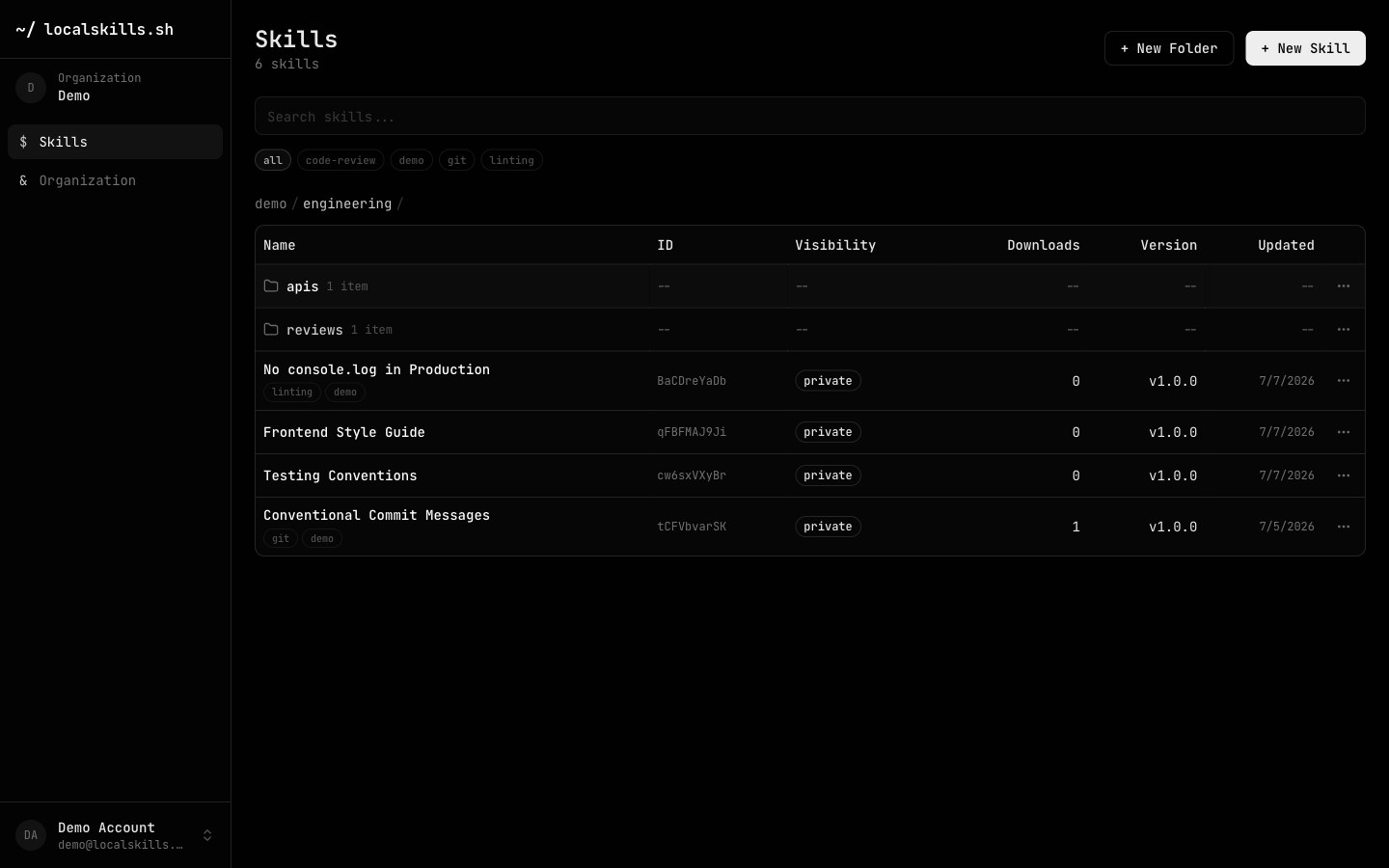
Create and manage folders anywhere you work: the dashboard (+ New Folder, and Rename, Move to…, Delete on each row), the CLI, or the API. Skills can be filed into a folder when created, or moved later:
$ localskills folders create engineering/reviews
$ localskills publish ./my-skill --folder engineering/reviews
$ localskills move my-skill engineering/reviews
Folder paths are organizational only — install identifiers (slug and public ID) never change when a skill moves between folders.
Restricting a folder
By default, private skills are visible to every organization member. Restricting a folder narrows that: its skills become hidden from everyone except the teams and members you grant access to (and admins, who always retain access).
Open Manage access from a folder's actions menu, enable Restrict this folder, and add grants:
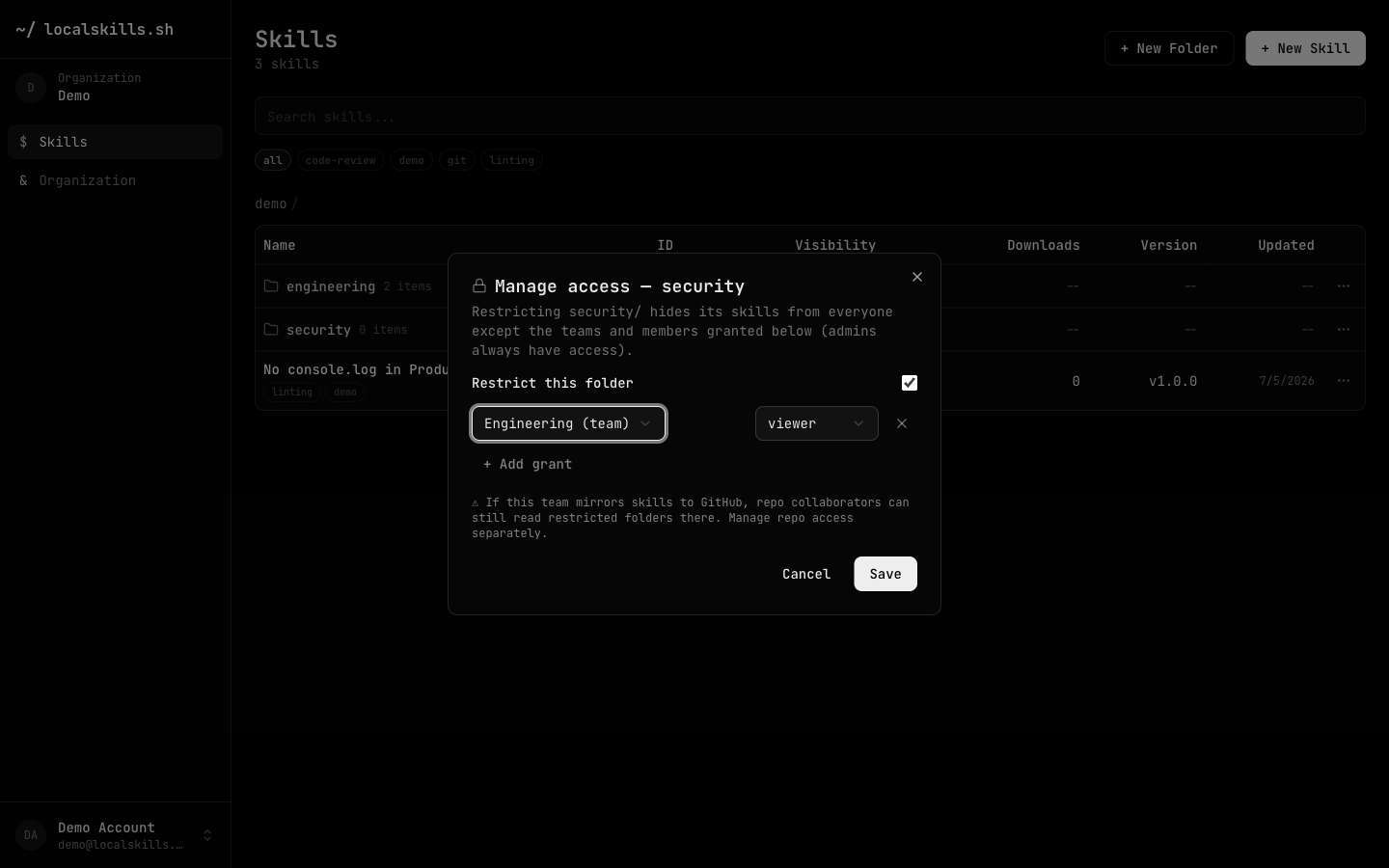
A restriction governs the folder and everything beneath it. If a subtree contains another restricted folder, the deepest restriction wins for the skills under it — so a broadly shared engineering/ can still contain a tightly held engineering/secrets/.
Grant levels
Grants go to teams or individual members, at one of three levels. Grants only ever cap what a person can do — they never add permissions beyond the person's organization roles.
| Level | Allows (up to your role's permissions) |
|---|---|
| viewer | Read the folder's skills. |
| editor | Read, create, update, and delete skills; manage subfolders. |
| manager | Everything editor allows, plus managing the folder's access grants. |
Anyone whose role carries the folders: manageAcl permission (built into owner and admin) bypasses restrictions entirely, and so do organization API tokens — they act as the organization itself.
Where restrictions apply
Restrictions are enforced everywhere skills are read: the dashboard, share pages, the REST API, the CLI, and the MCP server. A member without a grant doesn't see restricted skills in lists, search, or installs at all.
Auditing
Folder activity is captured in the organization audit log: folder.created, folder.updated, folder.deleted, and folder.acl_updated (with the restriction state and grant changes).